
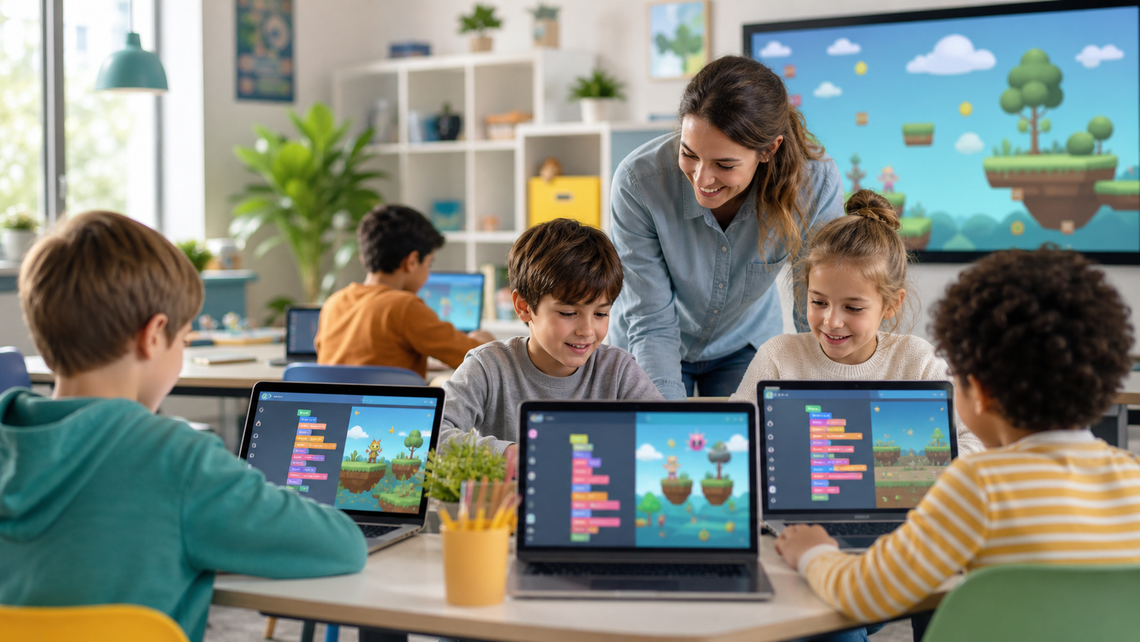
Super Techs for 6 to 11 year olds is built around a simple idea: children learn coding best when they are making something they care about. Students work through game projects, creative challenges and guided problem-solving so that coding feels practical, visual and rewarding.
The focus is not just screen time. Students learn how to plan, test, improve and explain their work. They build the habits that young coders need: patience, curiosity, careful reading, resilience when something breaks, and the confidence to try a different solution.
Game Design as the Starting Point
Most students begin with playful game-building. They create characters, backgrounds, movement, scoring, timers, levels, sound effects and simple win-or-lose conditions. This gives coding an immediate purpose: every instruction changes what happens in the game.
Because students can see the effect of their code, they learn quickly that precision matters. A missing instruction, incorrect order or unclear condition can change the whole game. That makes debugging feel meaningful rather than abstract.
Scratch-Style Block Coding
Younger students usually start with block coding because it lets them focus on logic before syntax. They work with sequences, events, loops, conditionals, variables, sprites, coordinates, broadcasts and simple game mechanics.
These ideas matter because they are the foundations of later programming. Students learn that code has structure, that instructions run in a particular order, and that a program can respond to a player, a timer or an event.
Creative Problem-Solving
Super Techs students are encouraged to make choices. They might change a character, adjust difficulty, add a new level, create a power-up, improve scoring or redesign a game world. These changes help students move from following instructions to thinking like designers.
We guide students to ask better questions: What should happen next? Why did that bug appear? How could the player understand the rules? What would make the game more fun without making it confusing?
Debugging and Resilience
Debugging is a core part of the course. Students learn to test one change at a time, read their code carefully, compare what they expected with what actually happened, and explain the problem clearly.
This is valuable beyond computing. Children develop persistence and attention to detail, especially when a project does not work the first time.
Progress, Badges and Confidence
Students build confidence through visible progress. Small achievements, badges, certificates and completed projects help children see that they are improving. That sense of progress is important for younger learners because it turns coding from a mystery into a skill they can practise.
As students become more confident, they can tackle longer challenges, combine ideas from earlier projects and explain how their code works.
What Parents Can Expect
Parents should expect a course that develops creativity and logic together. Students will not simply copy code. They will learn to make decisions, test ideas, fix mistakes and build small projects they can talk about with pride.
Join the Waiting List
Families can register interest here: