
Home Education in 2026: What Evidence Should Parents Be Keeping?
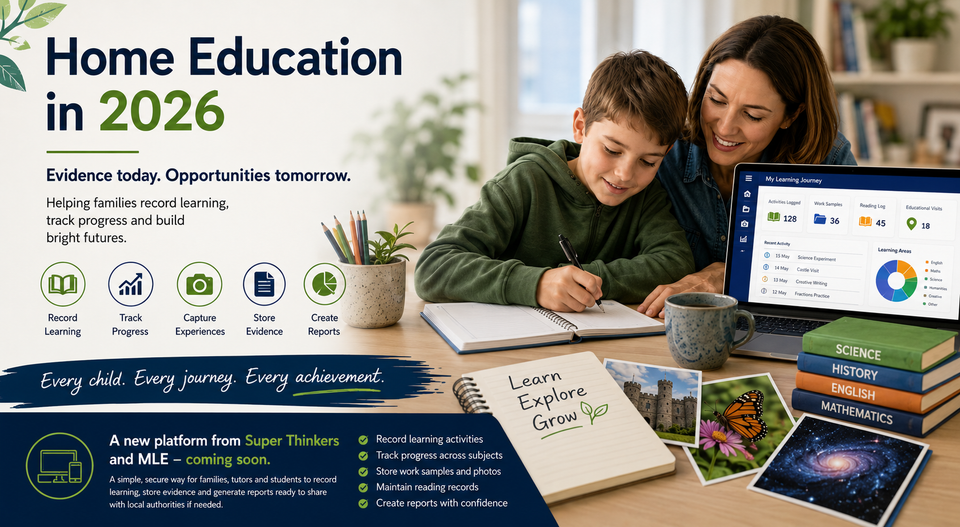
The landscape of home education in England is changing.
With the introduction of the Children's Wellbeing and Schools Act 2026, local authorities will have increased responsibilities for maintaining records of children who are educated outside of mainstream schools. While the legal duty placed upon parents remains fundamentally the same, namely to ensure that their child receives a suitable full-time education appropriate to their age, ability, aptitude and any special educational needs, the expectation for demonstrating that education may become more formalised.
For many home-educating families, this raises an important question:
"What evidence should I be keeping, and how should I present it?"
The Good News
The vast majority of home-educating parents are already doing far more than the law requires.
Every book read, museum visited, science experiment completed, coding project created, discussion held around the dinner table, and maths problem solved contributes towards a child's education. The challenge is often not the education itself, but recording and presenting it in a way that clearly demonstrates progress and breadth of learning.
Rather than viewing evidence collection as a burden, it can be seen as an opportunity to celebrate a child's achievements and create a valuable record of their educational journey.
What Evidence Should Be Kept?
A strong home education portfolio should ideally include:
Educational Philosophy
A short document explaining:
- Why you home educate.
- Your educational approach.
- How learning takes place.
- How progress is monitored.
- Your long-term goals for your child.
Every family is different, and local authorities should recognise this.
Learning Logs
Keeping a simple weekly or monthly record of activities can provide powerful evidence of education taking place.
Examples might include:
| Date | Activity | Subject |
|---|---|---|
| 12 September | Read chapters from The Hobbit | English |
| 13 September | Fractions and percentages practice | Mathematics |
| 14 September | Visit to Colchester Castle | History |
| 15 September | Scratch programming project | Computing |
Samples of Work
Parents should consider retaining:
- Creative writing
- Essays
- Maths exercises
- Science investigations
- Art projects
- Coding work
- Research projects
A small selection from throughout the year is usually sufficient.
Reading Records
A simple reading journal showing:
- Books read
- Audiobooks listened to
- Articles discussed
- Current affairs explored
can demonstrate significant literacy development.
Educational Visits
Many home-educating families provide rich experiential learning opportunities.
Recording visits to:
- Museums
- Historical sites
- Nature reserves
- Libraries
- Workshops
- Educational events
helps illustrate the breadth of a child's education.
Progress Reviews
A short review each term can summarise:
- Areas of progress
- New skills acquired
- Areas requiring further development
- Future learning goals
These reviews can be particularly useful if evidence is ever requested by a local authority.
Digital Portfolios Are Becoming Increasingly Important
Historically, many families have maintained folders, scrapbooks and paper records. While these remain valuable, digital portfolios are rapidly becoming the preferred method of organisation.
Digital systems allow parents to:
- Upload photographs.
- Store work samples.
- Track reading.
- Record learning activities.
- Produce reports.
- Demonstrate progression over time.
A well-maintained digital portfolio can provide a comprehensive overview of a child's educational journey within minutes.
Looking Towards the Future
As home education evolves, there is a growing need for tools that support families in maintaining records without turning home education into a bureaucratic exercise.
At Super Thinkers Ltd and Making Learning Easy (MLE), we recognise that parents, tutors and students need a simple, practical way to record learning, store evidence and demonstrate educational progress.
For this reason, we are currently developing a dedicated platform designed to help families:
- Record learning activities.
- Track progress across subjects.
- Store work samples and photographs.
- Maintain reading records.
- Create educational portfolios.
- Generate reports suitable for sharing with local authorities if required.
Our aim is not to recreate school administration. Instead, we want to provide a straightforward solution that allows families to focus on learning while ensuring that evidence of that learning is organised and accessible.
A Sensible Approach
The new legislation should not cause panic among home-educating families.
The strongest evidence of a suitable education has always been, and remains, a child who is learning, progressing and developing.
By maintaining simple records, retaining examples of work, and documenting educational experiences, parents can create a clear picture of the education they are providing.
Most importantly, they can do so without losing the flexibility, individuality and richness that make home education such a valuable option for many families.
As the educational landscape continues to evolve, Super Thinkers and Making Learning Easy remain committed to supporting families, tutors and students with practical solutions that place learning at the heart of everything they do.